Observe
See the readings together, with your own targets.
Garden Station — a modern hydroponics monitoring station.
A pH drift. A thirsty reservoir. The moment you added nutrients. See your garden’s conditions and your own actions together—and turn everyday readings into a story you can follow.
 Try the interactive screen ↗
A reading tells you what’s happening.
A history helps you understand why.
Take Garden Station for a test grow.
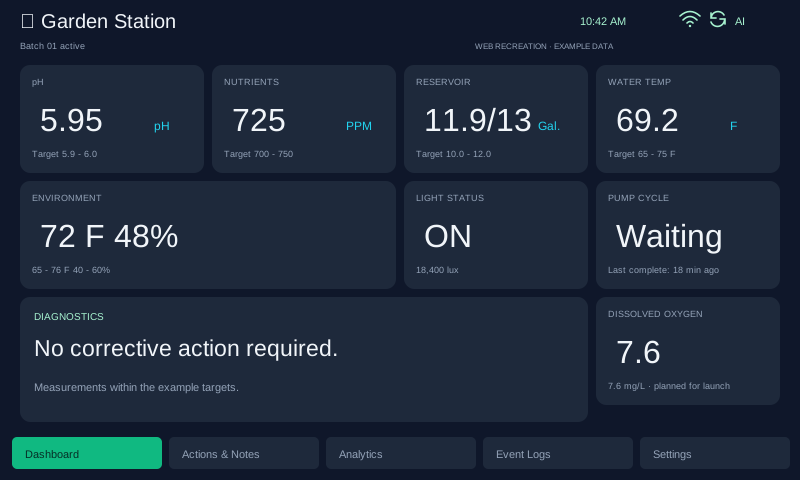
Every key condition, together. Hover over a tile to learn what it means. Click a supported sensor tile to explore its enable/disable control.
Screen recreations based on v0.9.45, plus planned dissolved oxygen support · sample readings
This panel changes to amber for a warning or red for a critical fault. Recommended actions appear immediately for out-of-range pH or very low water. Threshold alerts qualify after more than ten continuous minutes outside the limits; stale or invalid sensor data is diagnosed separately.
See the readings together, with your own targets.
Make the adjustment yourself. Record the moment.
Compare the event with the next readings.
The device publishes telemetry and operational events to a configured MQTT server. Long-term storage, spreadsheet ingestion and analysis require a receiving integration. The local display remains useful without that connection.
Keep the important conditions in view. Garden Station supports your decisions; the grower stays in control.
Water level and calibrated volume help you keep an eye on the reservoir.
pH and conductivity readings help you understand the nutrient solution. Chemistry requires the corresponding probes.
Water temperature, air temperature and humidity give you a fuller picture of growing conditions.
Ambient light readings add context to your garden. Lux is an illuminance measurement, not a PAR measurement.
Dissolved oxygen adds another view of your nutrient solution. The sensor is planned for the market version and included in this interactive preview.
An ultrasonic sensor measures reservoir distance. A six-point calibration maps those readings to volume for your reservoir. Refilling and calibration remain hands-on tasks.
The reservoir ECU collects measurements close to the probes, keeping sensitive sensor connections near the water.
A wired CAN link carries measurements to the seven-inch display. Local readings remain useful when Wi-Fi or an AI server is unavailable.
MQTT integration can share telemetry with a configured server. A shared Garden Station AI service is an idea we’re exploring, not an available subscription.
Garden Station is an independent project being developed toward small-batch builds. The next steps are restoring the reference unit, finishing the printed housing, and validating a repeatable PCB assembly.
Follow the project ↗Local readings, diagnostic alerts, calibration, sensor selection, and MQTT telemetry. Pump-cycle inference and overdue monitoring are previewed as planned firmware additions. Availability depends on installed hardware and valid measurements.
Remote notifications, longer-term trends, garden summaries, and a dedicated AI service or connections to your own AI server.
The market version will include a dissolved oxygen sensor. Explore its sample mg/L reading in the demo. Installation, calibration and firmware support remain development work before launch.
Interested in a hydroponics monitoring station for your garden? Leave your email for occasional development updates and news when small-batch builds become available.
US interest list · In development. No orders, deposits or payments are being accepted. Joining does not reserve a unit or commit you to a purchase.
Not yet. This preview introduces the project and collects feedback while the hardware is being refined.
The local monitoring design does not require a subscription. Hosted advanced features, such as AI integration and a mobile phone app, are being explored; no service or pricing has been committed.
Local sensor monitoring works independently of Wi-Fi and the AI server. Network features require a connection.
The initial hardware design is centered on Tower Garden. The ECU sits in the reservoir’s water-fill access opening and replaces the lid. The firmware supports other reservoir capacities, but adapting the housing and sensor mounting for other systems would require a redesign, which may be considered in the future.